SpaceX and SINGULUS: 100 GW of Solar Equipment for Orbital AI (Infographic)
SpaceX wants to put artificial intelligence in orbit, and it wants to make the solar cells that will power it itself. On 10 November 2026 the German equipment maker SINGULUS Technologies announced a contract to supply SpaceX with a complete production line for heterojunction (HJT) solar cells, the first step of a partnership that both companies say will grow to more than 100 gigawatts of manufacturing equipment. This infographic shows what was agreed, when, and what it is for.
🖼️ Get this infographic as a print →License this image →
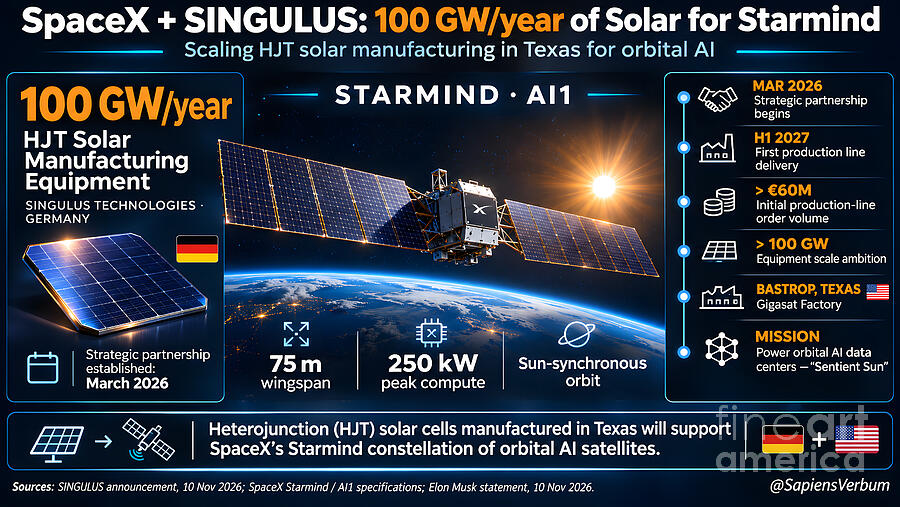
1. SINGULUS Technologies (Kahl am Main, Germany) will supply SpaceX with a turnkey production line for heterojunction (HJT) solar cells.
2. The first line is due for delivery in the first half of 2027; more lines are planned under a strategic partnership that began in March 2026.
3. The aim is to scale to more than 100 GW of production equipment as SpaceX builds up satellite manufacturing in Bastrop, Texas.
4. The cells are meant for Starmind, SpaceX’s planned satellites for computing in orbit. The first model, AI1, has a 75 m wingspan and up to 250 kW of peak compute.
5. The order value was reported at more than €60 million; SINGULUS itself did not disclose it.
Data as of: November 2026
The big picture
Data centres for artificial intelligence need enormous amounts of electricity, and on Earth that power is becoming hard to find. SpaceX’s answer is to move part of the computing into space, where a satellite in the right orbit can see the Sun almost all the time. Its planned Starmind satellites are designed as small orbital data centres. According to the details SpaceX has given, the first model, AI1, is a large spacecraft with solar wings spanning about 75 metres and standing about 30 metres high. It is designed for up to 250 kilowatts of peak computing power, about 175 kilowatts on average, flies in a sun-synchronous orbit and talks to the Starlink network by laser. SpaceX has also filed with the US Federal Communications Commission for a constellation of up to one million Starmind satellites, an extraordinary number that shows the scale of its ambition rather than a confirmed plan.
Every one of those satellites needs solar cells, and that is where SINGULUS comes in. The German company builds the vacuum coating machines used to make heterojunction cells, a type of silicon cell that combines crystalline silicon with very thin layers of amorphous silicon and is among the most efficient designs in mass production. In its announcement of 10 November 2026, SINGULUS said it had signed a supply contract with SpaceX for a complete HJT line, the first of several, and that production would scale to support more than 100 GW of equipment as SpaceX speeds up satellite manufacturing in Bastrop, Texas. Mike Nicolls, SpaceX’s senior vice president for Starlink, was quoted as saying the cells would power the Starmind satellites. Elon Musk described the plan on X as 100 GW per year of HJT solar manufacturing equipment.
What the numbers mean
100 GW. This is the headline figure, and it is a target, not a factory that exists today. It describes the capacity of the manufacturing equipment the partnership aims to reach, not the power of the satellites in orbit. For scale, 100 GW is roughly the output of a hundred large power stations; a single AI1 satellite is designed for a few hundred kilowatts.
More than €60 million. Some reports put the first order at over €60 million, while others said the value was not disclosed; the SINGULUS announcement itself gives no figure. Either way, it is large for a company whose revenue in 2025 was about €48 million, which explains why the news mattered so much for SINGULUS.
H1 2027 and March 2026. The partnership began in March 2026, when SpaceX also started to finance SINGULUS; more funding followed in October 2026. The first production line is due in the first half of 2027. Until then, Starmind remains a plan on paper, and the 100 GW figure a direction of travel rather than a result.
The infographic gathers these points on one page: the German equipment, the Texas factory, the satellite, and the timeline from partnership to first delivery.
You are welcome to embed it on your site with a link back to this page:
<a href="https://infographics.sapiensverbum.com/2026/11/spacex-and-singulus-100-gw-of-solar.html"><img src="https://images.imagerenderer.com/images/artworkimages/mediumlarge/3/spacex-plus-singulus-100-gw-of-solar-power-for-orbital-ai-starmind-sapiens-verbum.jpg" alt="SpaceX + SINGULUS: 100 GW of solar for Starmind, infographic" width="800"></a><br>Infographic by <a href="https://infographics.sapiensverbum.com/2026/11/spacex-and-singulus-100-gw-of-solar.html">Sapiens Verbum</a>
For an office, a classroom or anyone who follows space and AI: this infographic is available as a poster, canvas or framed print from the Sapiens Verbum print shop.
Choose your size and frame →License this infographic
Printed and shipped by Fine Art America · 30-day money-back guarantee
💬 Over to you: Would you trust a data centre in orbit more or less than one on the ground? And where in the world are you reading from? Tell us in the comments.
Sources
- SINGULUS Technologies: SpaceX and SINGULUS, heterojunction solar cells (press release, 10 November 2026)
- Interesting Engineering: SpaceX orders HJT solar cell production line from SINGULUS (10 November 2026)
- Wikipedia: Starmind (satellite)
- ANI: SpaceX partners with Germany’s Singulus to scale solar cell manufacturing capacity beyond 100 GW (11 November 2026)
- FourWeekMBA: SpaceX Orders Solar Cell Line From €48M-Revenue Singulus (November 2026)
- FourWeekMBA: Singulus Prices SpaceX’s First Solar Line Above €60 Million (November 2026)
Comments
Post a Comment